The State of Apparel: Is Anyone Actually Loyal to a Single Brand Anymore?
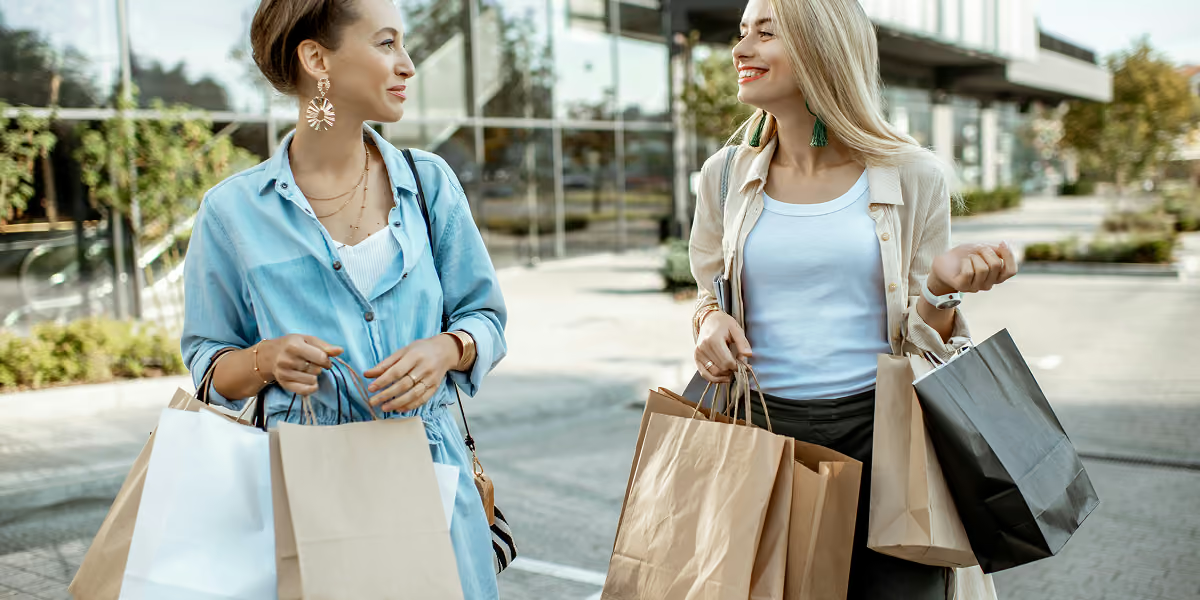
From Shein to Uniqlo to J.Crew, consumers are shopping across the entire spectrum of fashion retail — and the brands that don’t understand that are the ones losing ground.
Walk into any conversation about fashion retail and the word “loyalty” comes up quickly. But ask the marketers and strategists tracking actual consumer behavior, and a more complicated picture emerges: shoppers aren’t abandoning brand loyalty so much as redefining what it means.
The old model, where, say, a consumer devoted to one or two labels returns reliably across seasons, has given way to something more fluid.
“Shoppers don’t have a favorite brand anymore; they have a lineup,” says Allen Adamson, co-founder of brand consultancy Metaforce. “The wardrobe is a playlist, not an album.”
Everyone Shops Everywhere
The overlap among seemingly competing fashion brands is nearly total among younger consumers, and that’s by design.
Heather Salkin, CEO of Artists & Robots, a creative intelligence studio, describes a shopping ecosystem in which the same consumer might turn to Shein or Zara for trend-driven pieces, Uniqlo for elevated basics, Everlane for perceived quality and sustainability, and J.Crew or Banana Republic for workwear — all within the same year, without seeing any contradiction in that behavior.
“The reality is that the same consumer may shop all of these brands over the course of a year without seeing that behavior as contradictory,” Salkin says.
Adamson puts it in terms of functional roles. “Uniqlo ‘owns’ basics. Zara ‘owns’ trend. Shein ‘owns’ cheap thrills. Everlane ‘owns’ conscience,” he says. “Young shoppers shop all of them, each for a different job.” The danger, he adds, comes when brands in the middle of the market chase the same trends at the same speed. “When Zara, H&M and Mango all chase the same trend at the same speed, sameness kills loyalty faster than price does.”
Trend Loyalty vs. Brand Loyalty
For Gen Z in particular, the loyalty question requires a different frame entirely.
Matt Peters, president and managing partner of 71 West, a social and content agency for luxury brands, identifies two forces reshaping how younger consumers attach to brands.
“Gen Z is far more likely than other generations to buy something because it’s trending on social media,” Peters says. “They often use owning the trending thing as in-group signaling the way Boomers use watches. Some have started referring to this as ‘trend loyalty’ over ‘brand loyalty.’”
The second force is equally significant: Gen Z doesn’t inherit brand loyalties the way previous generations did. “They’ll switch the moment they find something better or more closely aligned with their personal values,” Peters says.
Caroline Seklir, head of strategy at Yard NYC, an independent creative agency, pushes back slightly on the idea that brand equity has become irrelevant.
“They’re also highly brand aware,” Seklir says of Gen Z shoppers. “Most have go-to brands for specific needs, and the growth of secondhand has actually made brand equity more important. They don’t just want a ‘90s bag — they want the Prada or the Coach. When it’s all about search terms and nostalgia-nods, brand matters more than ever.” The distinction she draws is between brand agnosticism and brand pluralism. Shoppers are spreading spend across more retailers, but they haven’t stopped caring about what brands represent.
The Personal Style Algorithm
Lana McGilvray, founder and CEO of Purpose Worldwide, describes what she calls “masstige behavior.” She defines “masstige” consumers as building a personal mix of mass and prestige brands rather than committing to a single retail ecosystem. The behavior cuts across price points, platforms, and purchase occasions in ways that challenge traditional loyalty assumptions.
“Loyalty today is less about sticking to one retailer and more about sticking to a personal style algorithm,” McGilvray says, “the mix of brands that fits their values, budget, and the trend cycle they’re following that week.”
AI and social media are accelerating that dynamic in ways brands are still learning to navigate. Salkin points to the precision-targeting and rapid repetition of trend messaging as a force that drives impulse purchasing across the entire category — generating the kind of coordinated cultural moments where consumers discover independently that they’ve all bought the same “obscure” accessory.
“We also need to consider how AI and social media promote trends, pushed by influencers, that can have a profound impact on impulse purchasing in fashion,” Salkin adds.
Adamson traces the structural shift to a single cause. “Loyalty was always somewhat a function of friction,” he notes. “When switching was hard, people stayed. Now, every brand in the world is one thumb swipe away.” Department stores feel that most acutely. “Macy’s original job was aggregation,” Adamson says. “One roof, every brand. Your phone does that job better now.”
What emerges from these conversations is less a story about loyalty dying than about loyalty changing form. “Increasingly, consumers aren’t building relationships with a single brand,” Salkin says. “They’re building a portfolio of brands that collectively reflects their identity.”
.png)


Stay ahead of the story.
Get the latest from The Outcome—expert takes on the industry, emerging trends and exclusive insights into how consumers are actually spending.