Soccer’s Marketing Puzzle: How Brands Can Win the World Cup Without a Playbook
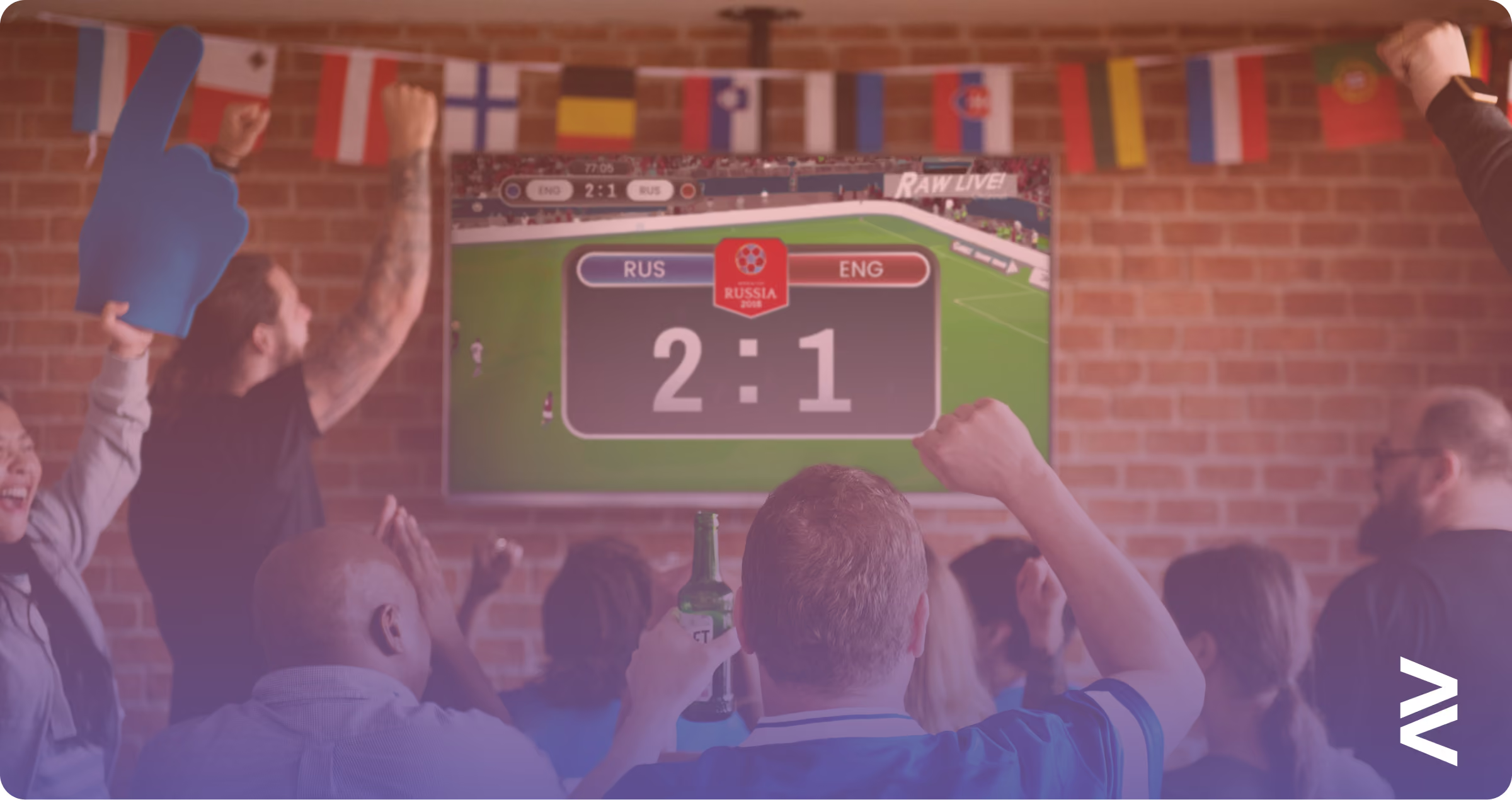
The 2026 FIFA World Cup represents a huge, and very different, advertising opportunity that is structurally unfamiliar for American brands accustomed to the stop-start rhythms of football, basketball, and baseball. Can marketers win it without an established game plan?
The FIFA World Cup arrives on American soil this week carrying the kind of global scale that few tentpole events outside of the Olympics and The Super Bowl can match. But that’s not to say advertisers will have it easy.
In terms of advantages, billions of viewers across dozens of countries will follow 64 matches over the June 11-July 19 tournament being held across North America. For context, consider that the Olympics tends to run about 16 days; and the Super Bowl broadcast rarely goes to four hours in a single Sunday evening.
The Difference is Structural
The World Cup promises to transform cities, reorganize daily routines, and generate sustained cultural conversation unlike any other sports event. For American brands, the opportunity is real. But so is the challenge of figuring out how to activate against a sport that doesn’t accommodate them the way domestic properties do.
The most fundamental difference is structural. Soccer runs in two 45-minute halves with no commercial timeouts, no television breaks between plays, and no natural pause points of the kind that make the NFL and NBA relatively straightforward environments for 30-second spot advertising. The formats that built American sports marketing don’t apply.
“Soccer doesn't stop for commercials,” says David Swaebe, head of Growth, Americas at marketing agency Ebiquity. “That makes the 2026 World Cup one of the most constrained media environments in sports history.”
Live broadcast inventory is largely sold out, Swaebe adds. The real opportunity now is in the content surrounding the game. He points to shoulder content, studio analysis, match previews, post-game coverage, they all deliver engaged audiences at a fraction of live CPMs.
“Brands focused only on the live window are overpaying,” Swaebe says. ”Advertisers need to think carefully about the distribution realities of this year's World Cup. The World Cup is sold as a mass-reach event in a media environment that no longer reliably delivers that kind of concentration.”
Streaming fragmentation means there is no single place where the World Cup audience lives, Swaebe notes. Reach and frequency models built on household assumptions break down when the same viewer is spread across five platforms with inconsistent identity resolution. That tension belongs at the center of every planning conversation. Brands need cross-platform measurement or they are flying blind on half their buy.
“In fragmentation, there is also a unique opportunity to think globally and act locally around the World Cup,” Swaebe says. “With a combination of 11 host cities, national scale, and local pricing, there's a big arbitrage option for advertisers to target key markets with their World Cup plans.”
A Month, Not a Moment
Meghan Walsh, SVP of client strategy at out-of-home advertising company Talon, frames the World Cup’s timeline as its defining commercial characteristic. “The World Cup unfolds over the course of a month and creates dozens of opportunities for brands to engage consumers,” Walsh says. “This extended timeline allows brands to move beyond a one-time appearance and establish a sustained presence throughout the tournament.”
That sustained presence changes the math for out-of-home in particular. Walsh points to stadium perimeters, fan zones, sports bars, transit hubs, and viewing destinations as environments where dynamic creative can engage audiences in real time. There’s the counting down to kickoff to reacting to goals as they happen (or are missed).
The absence of obvious commercial breaks inside the broadcast doesn’t eliminate the advertising opportunity, but it does relocate it.
Tom Ramsden, managing director of Sid Lee Sport USA, sees the extended window as a strategic asset that brands have historically underused. “The extended engagement window before, during and after the tournament gives brands a rare opportunity to build long-term equity through the emotional connection that football, sports and the World Cup uniquely create,” Ramsden says.
In Ramsden’s view, it’s a matter of executing against that window without defaulting to the same creative formulas that produce what he calls “category wallpaper” — sponsorship activations indistinguishable from one another, visible in volume but absent in impact.
Most American brands are deeply familiar with football culture, Super Bowl culture, March Madness culture, and the rhythms of domestic sports. Soccer is different, says Feleceia Wilson, Strategy Principal at full-service agency LERMA. The World Cup brings a global sports ritual into a U.S. environment where enthusiasm is growing, but fluency is uneven. That gap is the opportunity, she says.
“In the U.S., the World Cup asks brands to play host, translator, and participant before they play advertiser,” Wilson says. “Brands are not only reaching people who already love the game. They are also helping casual fans, families, host-city communities, and curious Americans understand how to enter the moment.”
The scale of the World Cup can make the audience feel impossibly broad, but the smarter move may be to choose a more specific point of entry, Wilson says. A brand does not have to speak to every fan, in every city, in every language, all at once. It can build relevance by understanding one real audience deeply: the lifelong fan, the diaspora family, the host-city resident, the youth soccer parent, the casual American sports fan, or the person who wants in but does not yet know where they fit.
“The brands that succeed will not simply borrow the scale of the World Cup,” Wilson notes. “They will find a credible role inside the way people are actually gathering, learning, watching, shopping, traveling, and connecting.”
Branding and Performance on the Same Team
The question American brands bring to the World Cup comes down to this: how to balance awareness objectives against measurable performance outcomes? One direct answer to that question comes from Sergio Gordilho, partner, co-president, and CCO at Africa Creative, which is based in São Paulo, Brazil. As Gordilho sees it, the tension between brand and performance is a false choice specific to less emotionally charged environments. “The World Cup reminds us that people don’t buy products first,” Gordilho says. “They buy meaning.”
During the tournament, he argues, branding generates emotional proximity and performance captures the momentum that proximity creates. Advertisers that treat the two as competing budget line items miss how the dynamic actually works during a global event where consumers are operating as supporters and believers rather than as transactional buyers. “Performance is often the scoreboard,” Gordilho says. “Branding is the game.”
For official sponsors, the brand opportunity is obvious: awareness, association, affinity, and scale, Benton says. But performance should come from the behaviors the tournament naturally creates. People are planning watch parties, buying food, upgrading home spaces, traveling, buying gear, following teams, sharing content, and looking for local ways to participate.
“The mistake would be treating every touchpoint like a transaction,” Benton says. “Some moments should build meaning. Some should build trust. Some should help people feel oriented. And some should make the next action easy.”
That balance matters even more in the U.S., where many people may be interested in the World Cup without being deeply familiar with soccer culture, Benton adds. Performance may depend on invitation as much as promotion. Brands have to give people a clear way in before they ask them to take action.
“The strongest brands will create a connected system: emotional storytelling at the top, culturally specific engagement in the middle, and clear, useful conversion points closer to the moment of action,” Benton says.
Most World Cup viewers are there for the cultural moment, not the match, Ebiquity's Swaebe adds.
“Brands that buy reach without understanding intent will pay premium prices for casual attention,” Swaebe says. ‘Reach’ is not ‘relevance.’ The World Cup will deliver one. Brands have to earn the other with compelling messaging, activations, and calls to action. We're seeing an audience quality paradox in the U.S., where 32% of the population will watch, but only 10% are genuinely interested in soccer. That gap is where ad spend goes to die.”
Walsh draws a similar conclusion from a media placement perspective. World Cup participation builds familiarity, trust, and cultural relevance that outlasts the tournament itself. “These moments of resonance do more than drive awareness,” she says. “They strengthen brand affinity, influence future consideration and purchase decisions, and create lasting connections.”
No Universal Playbook
Where brands tend to go wrong, according to Ramsden, is treating the World Cup as a larger version of something they already know how to buy. The Super Bowl has a domestic audience concentrated in a single media environment for a single evening. The World Cup activates entire countries simultaneously across wildly different cultural contexts, languages, and levels of soccer passion. “Unlike the Super Bowl, which is largely a monocultural event, the World Cup is a truly global and multicultural phenomenon,” Ramsden says. “What resonates in one market can easily miss the mark, or even create risk, in another.”
That complexity demands something most brands resist building: market-specific strategy with enough flexibility to remain coherent at scale. Gordilho puts it in terms of belonging rather than exposure. The most valuable impression at a World Cup isn’t the one a brand purchases — it’s the one it earns by participating authentically in something people already care about. The brands that arrive with a single global message and a Super Bowl mindset will find those impressions harder to earn than they expected.
For American advertisers, the 2026 tournament represents a test of whether they can operate effectively in an environment that doesn’t conform to their standard formats. The audience is there. The cultural moment is real. The question is whether the marketing infrastructure — creative, measurement, activation strategy — is built for a month of sustained engagement rather than a single high-stakes broadcast window.
“The key is playing to the format’s strengths rather than forcing a playbook that doesn’t fit,” adds Alicia Gehring, SVP, Media Strategy at WHITE64. “Pitch-side boards and stadium presence do the brand-building heavy lifting, they create goodwill simply by showing up for something fans deeply love. But brands can layer in performance by tying specific promotions, offers, and rewards to the World Cup viewing experience, turning passive awareness into active engagement. Create a journey: fans notice you, align with you, and then have a reason to act. And one more thing, if you want to signal that you actually get this audience, call it ‘fútbol.’”
.png)

Stay ahead of the story.
Get the latest from The Outcome—expert takes on the industry, emerging trends and exclusive insights into how consumers are actually spending.