Field of Streams: Baseball’s Distribution Strategy Delivers Opening Day Audience Hits
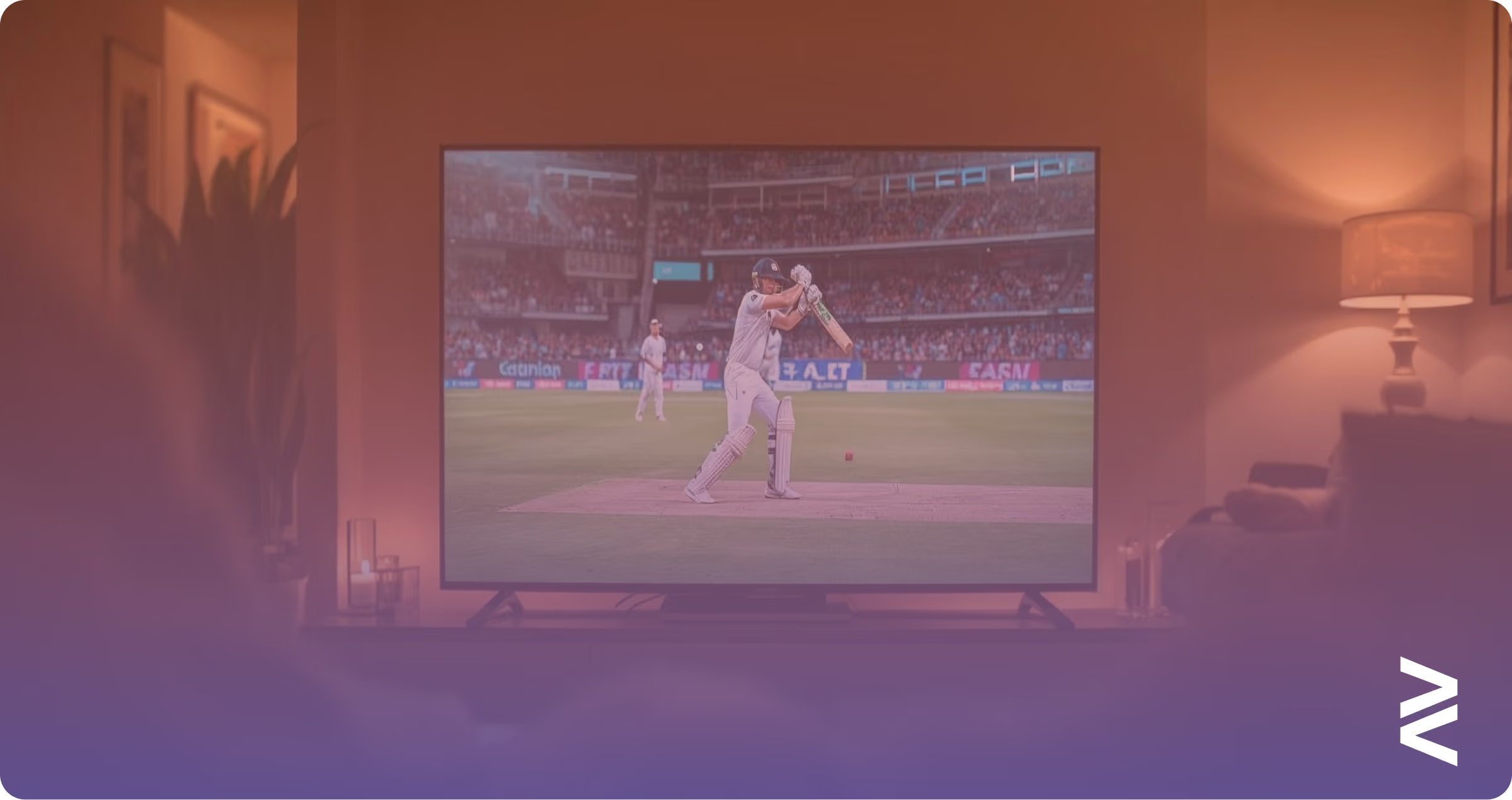
MLB’s new media rights deal scattered Opening Day games across Netflix, NBC, and Fox generated the strongest first-week audiences in nearly a decade. But advertisers must now rethink how they reach fans across platforms rather than relying on single broadcast windows.
Major League Baseball’s 2026 season opened with measurably stronger viewership than recent years, validating the league’s decision to distribute games across streaming and traditional broadcast partners rather than consolidating around a single platform.
But if MLB builds its bigger TV playing field, will advertisers and viewers come? (Apologies to fans of the 1989 movie Field of Dreams.)
The answer appears to be “yes.” The numbers for MLB’s openers affirmed that view, as Netflix’s Yankees-Giants season opener drew 2.97 million viewers, while NBC’s Dodgers-Diamondbacks primetime game attracted 3.2 million across linear and Peacock, according to The Hollywood Reporter.
Both telecasts represented the highest Opening Day primetime audiences since 2017, not counting the anomaly of the pandemic-shortened 2020 season.
Year-over-year comparisons tell the distribution story plainly. Last year’s single opener on ESPN averaged 1.9 million viewers, putting both the Netflix and NBC games more than 50% ahead. Fox’s inaugural Saturday slate averaged 2.59 million viewers, up 45% from the same weekend in 2025.
“Baseball didn’t suddenly get more popular. It got better distributed,” says Jason Alan Snyder, co-founder of intelligent creative studio Artists & Robots. “The audience was always there. It was just trapped behind the wrong deals.”
New Rights Deal Fragments Reach Across Six Partners
The new three-year media rights agreement positions NBC Sports as the Sunday night partner for much of the season, while Netflix streams select marquee events including the season opener and All-Star Home Run Derby. Fox Sports, TNT Sports, and Apple remain partners, and ESPN scaled back on-air telecasts but acquired streaming service MLB.TV, which offers subscribers every out-of-market game.
For advertisers, the expanded distribution creates both reach opportunities and planning complexity, creating a whole new playing field for advertisers.
“Advertisers should expect continued fragmentation across sports media as leagues expand rights deals across linear and streaming partners,” says Alicia Gehring, SVP of media strategy at independent agency WHITE64. “For advertisers, that means planning holistically across channels will be essential to maintain reach.”
The fragmentation represents a shift from traditional sports media planning, where a single broadcast partner could deliver mass audience concentration. Baseball’s 162-game season now requires brands to maintain presence across platforms rather than concentrating spend around a handful of high-profile broadcasts.
“Live sports is one of the last places where you can reach an audience that is fully present and emotionally invested in real time,” says Allen Adamson, co-founder and managing partner of brand consultancy Metaforce. “The Opening Day numbers confirmed that baseball still has that pull.”
New Tech, New Advertiser Opportunities
The league’s product improvements have contributed to audience retention beyond Opening Day excitement. Rule changes including the pitch clock have accelerated game pace, making broadcasts more compatible with contemporary attention patterns. “Baseball fixed its product. The pitch clock made the game faster, sharper, and more watchable,” Adamson says. “Now marketers need to do the same.”
Technology integration extends beyond broadcast to the fan experience itself, Snyder notes. He points to the MLB’s Scout Insights tool, which delivers real-time AI-generated narrative context directly within the Gameday experience, pitch-by-pitch analysis, matchup histories, and statistical anomalies as they occur. The Automated Ball-Strike Challenge System introduces AI-assisted pitch calling for the first time in the sport’s 180-year history.
“The sport is now being instrumented at a level that can make a data scientist blush,” Snyder says. “Advertisers who understand that are sitting on a gold mine.”
The data infrastructure creates opportunities for advertisers willing to move beyond generic national messaging. Every platform choice represents declared consumer preference, and every subscription functions as an identity signal.
According to Snyder, these expanded options for advertisers and viewers might need to be considered something other than the media fragmentation that has confronted the ad landscape since the emergence of cable TV nearly a half-century ago.
“MLB’s new rights deal stretches across Netflix, NBC, Fox, ESPN, Apple, and TNT, and that’s not fragmentation, that’s a fingerprint,” Snyder says. “The league has essentially built a first-party data architecture out of broadcast rights, and most advertisers haven’t noticed yet.”
Fan Behavior Demands Real-Time Brand Responsiveness
Fan behavior has evolved alongside distribution and technology changes. “Today’s baseball fan is watching on Netflix, betting on the next pitch, and posting a highlight on TikTok before the inning is over,” Adamson says. “Marketers who are still thinking about TV spots and stadium signs will be left in the bullpen.”
Heather Salkin, CEO of intelligent design studio Artists & Robots, describes the current environment as requiring brands to operate at the speed of cultural conversation. “Baseball this year is less a season and more of a moving target because it is spread across screens, fueled by unpredictable storylines, and shaped by tech and culture in real time,” Salkin says.
“If a brand can’t keep up and move at the speed of trends, it’s missing the moment.”
The length of the baseball season creates distinct advantages for advertisers capable of sustained engagement. “With 162 games, brands have the opportunity to show up consistently and build real relevance with fans,” says Scott Felenstein, chief revenue officer of digital out of home network TVM Media, which features vertical screens in sports bars nationwide.
Geographic and contextual specificity will differentiate successful campaigns from generic approaches. “The Guardians’ fan in Cleveland is not the Dodgers fan in Los Angeles. The Tuesday night fan is not the playoff fan,” Snyder says. “Baseball runs 162 games. That’s 162 opportunities to show up with something relevant or 162 opportunities to prove you weren’t paying attention.”
Out-of-home viewing contexts represent another layer of audience engagement that traditional measurement may undercount. “A huge part of baseball viewing happens outside the home—in bars, restaurants, and social settings where fans gather, engage, and watch for extended periods,” Felenstein says. “That’s where attention is high and the experience is shared.”
Brands that succeed this season will combine platform sophistication with cultural responsiveness. “Brands should focus on using AI to ride real-time storylines with teams and players during heated moments, like opening day, rival team games, trade deadlines, and playoff pushes,” Salkin says. “If your brand isn’t part of the conversation in a well timed authentic way, it’s already benched.”



Stay ahead of the story.
Get the latest from The Outcome—expert takes on the industry, emerging trends and exclusive insights into how consumers are actually spending.