What Will Agentic AI Do To Programmatic Advertising?
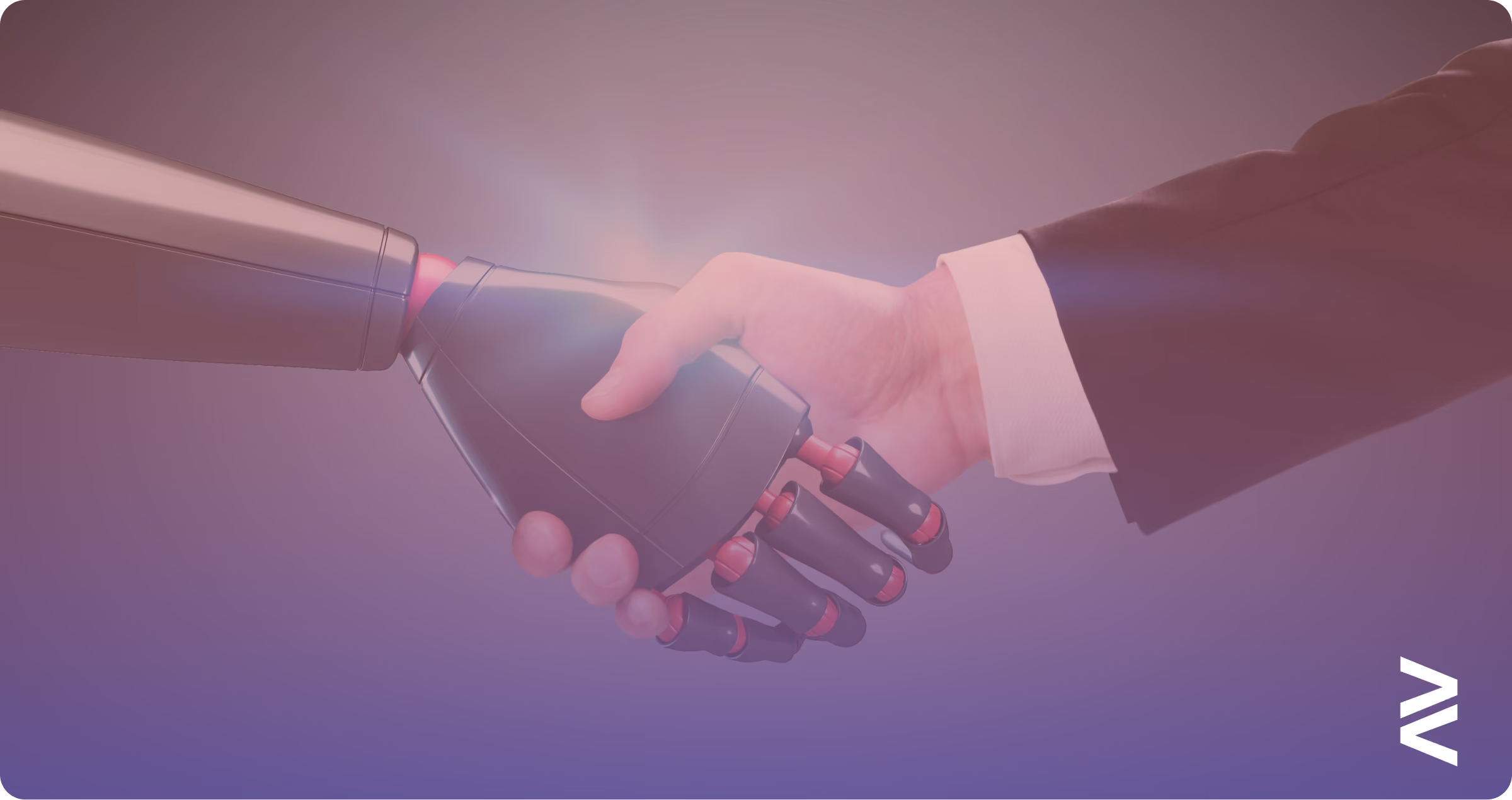
Industry experts predict agentic AI will shift media buying processes from manual optimization to autonomous execution, collapsing the divide between media allocation and production while elevating strategy, governance, and creative resonance as the true competitive differentiators.
The infrastructure for agentic AI in programmatic advertising is already being built. The IAB Tech Lab released its Agentic Roadmap in January, extending standards like OpenRTB with new protocols for agent-to-agent trading. PubMatic’s AgenticOS is live with partners running real campaigns, and DSPs like Yahoo are embedding agentic structure directly into their platforms.
But while the technology accelerates, the industry remains divided on what this transformation actually means. Some see it as automation with more steps—algorithmic optimization expanding its scope. Others recognize something more fundamental: a shift from humans managing campaigns to humans governing autonomous systems that make strategic tradeoffs across the entire ecosystem in real time.
The Outcome asked programmatic strategists, media buyers, and AI specialists what agentic AI will do to their industry. Their responses reveal three distinct shifts, all of them ushering technology in, while re-focusing on human expertise: the collapse of traditional optimization advantages, the rise of agent governance as a new discipline, and total reframing of what programmatic actually optimizes for.
The End of Optimization as Competitive Advantage
“Agentic AI will quietly kill the industry’s obsession with media optimization,” says Nick Rogers, VP of Media Strategy at The Variable. “If machines can instantly adjust bids, placements, audiences, channels, and improve decision-making, the marginal gains from optimization disappear. Everyone will have access to the same capabilities.”
Rogers argues that universal access to agentic systems fundamentally changes what drives programmatic performance. “When that happens, the real driver of performance becomes the idea itself: the creative, the story, and the message people respond to,” he says. “AI can optimize distribution, but it still takes human insight to create meaning. If the creative isn’t compelling or the message doesn’t resonate, no AI agent can fix that.”
The shift represents a strategic reorientation for an industry that has spent the past decade obsessing over incremental bid optimization, audience targeting refinements, and placement strategies. As those capabilities become table stakes through AI agents, competitive advantage moves upstream to the quality of ideas and creative execution.
From Campaign Managers to Agent Governors
The operational impact on programmatic teams centers on role transformation: from campaign executors to agent governors.
“Agentic AI will significantly streamline programmatic advertising by automating many of the tasks that currently require manual work,” says Kevin O’Malley, co-founder of AdDaptive. “It will accelerate the creation and activation of audiences, handle campaign setup, continuously optimize bids and budgets, and automatically generate reporting, analysis, and recommendations for future campaigns. Instead of traders manually managing campaigns day to day, AI agents will be able to monitor performance in real time and make adjustments at machine speed.”
But O’Malley emphasizes that automation doesn’t eliminate human expertise—it reframes it. “Humans will remain an essential part of the process,” he says. “AI can process massive amounts of data and identify patterns quickly, but it still lacks the judgment, context, and market intuition that experienced programmatic professionals bring to the table.
The most effective model will likely be a human-in-the-loop approach where AI handles the heavy lifting while experts guide strategy, interpret results, and ensure campaigns align with business objectives.”
Amy Gerhart, media supervisor of digital investment at 22squared, describes the new role succinctly: “This shift can see programmatic traders become agent governors—focused on establishing goals and constraints and leading the strategic conversation differently as you can’t give total autonomy without guardrails. This is especially for inventory and brand safety-conscious clients. The tech needs to be optimized to serve our clients’ needs, not a platform’s.”
Saad Rawala, media director of digital investment at 22squared, adds that the new technology/human collaboration elevates strategic thinking. “It’ll require the trading teams to be even more strategic about their plans as the focus moves away from redundant execution tasks to now being more strategic,” he says. “Instead of spending time on striking programmatic deals, troubleshooting delivery, the teams will focus on developing robust goals and guardrails since the performance will only be as good as the inputs.”
Chris Kotyck, EVP of digital operations at Coegi, frames the transition in infrastructure terms. “Most of the industry is still thinking about agentic AI as ‘automation with more steps,’“ he says. “And honestly, the line between smart algorithms and true agents is blurry. We already use algorithmic optimization across programmatic and social to manage bidding, pacing, and delivery. The difference with agentic AI is scope of autonomy. Instead of an algorithm optimizing within the rules a human sets on a single platform, agentic systems will make strategic tradeoffs across the ecosystem—reallocating budget mid-flight, negotiating deal terms dynamically, adjusting strategy based on its own reasoning rather than a fixed playbook.”
Kotyck acknowledges the industry isn’t there yet but sees the foundation being laid rapidly. “I don’t expect that to be fully the case in 2026, but the infrastructure is already being built and it’s coming,” he says. “As agents take over more of the execution layer, the value shifts to those who can design and orchestrate the ecosystem best. Data readiness becomes critical—agents are only as good as the signals they’re fed. Orchestration design matters—who defines the rules, constraints, and objectives agents operate within.”
Beyond Clicks: Optimizing for Machine Decision-Making
Perhaps the most fundamental shift involves rethinking what programmatic advertising actually optimizes for as AI assistants increasingly research, compare, and purchase on behalf of consumers.
“Agentic AI will push programmatic beyond optimization and into the execution layer of media buying,” says Gareth Neville, director of global growth at Kepler. “For the past decade, programmatic has focused on predicting which ad a person is most likely to click in a given moment. As AI assistants increasingly research, compare and even purchase on behalf of consumers, the optimization target shifts from persuading a human in a browsing session to influencing the signals machines use to make decisions.”
Neville argues this “will drive programmatic systems to optimize structured signals such as product data, pricing, availability, reviews and retailer presence that shape how AI agents rank and recommend products.” In a dramatic alteration of programmatic strategy, “publishers, ad tech platforms, agencies and marketers will increasingly test agent-to-agent programmatic activation, where natural language interactions trigger buying and selling workflows across interoperable platforms.”
The governance challenge extends beyond individual campaigns to ecosystem-level responsibility. “While many brands are piloting agentic systems, far fewer have integrated them operationally,” Neville says. “The competitive edge will not be who has AI, but who governs interoperable AI systems responsibly with strong oversight, transparency and auditability of automated decision making.”
Heather Salkin, CEO of creative intelligence studio Artists & Robots, sees the shift affecting traditional organizational silos. “What excites me most about Agentic AI is the collapse of the traditional divide between media allocation and creative,” she says. “They will become a single co-optimized system, continuously generating and testing thousands of micro-variants in real time. That shift fundamentally changes how programmatic workflows operate.”
The convergence of media and creative optimization through agentic systems enables a level of dynamic personalization that current programmatic infrastructure can’t support at scale.
“Agentic AI will take FOMO away from programmatic buyers,” says Alicia Gehring, SVP of media strategy at White64. “When buying programmatic, audience targeting is based on static and sometimes ambiguous definitions. But by working with GenAI to evaluate performance indicators, campaigns will be personalized and efficient, helping buyers to actually get more in-depth input on campaign success metrics.”
Jenny Yeend, executive director of media planning and strategy at 22squared, describes an operational shift from rule-based to objective-based logic.
“One impact we will see is a move toward objective-based logic—current bid technology optimizes on if/then logic: ‘If a site doesn’t deliver a .1% CTR, remove it,’“ she says. “With the advancement of Agentic AI, advertisers have more dynamic opportunities to meet KPI goals, as you can set more complex requests: ‘Maintain a $23 CPA, while allocating 20% of the budget to prospecting.’
Doing this allows for real-time dynamic reallocation by channel, by creative.”
Yeend also emphasizes the organizational impact. “Creative and media have the opportunity to be less siloed because data can notice creative insights and work with creative agents—or insight derivation guidance—to create variations of ads that are performing well,” Yeend says.
Kotyck frames the moment as an inflection point for the industry. “We’re on the precipice of something significant,” he says. “For the first time, we have a real shot at marrying the technical efficiency of agentic AI with the thoughtful human mind, driving campaign performance and client satisfaction hand in hand with technology, not in spite of it. If that means we can all work a little smarter and worry a little less, that’s a pretty nice start for the agentic era of programmatic.”

.png)

Stay ahead of the story.
Get the latest from The Outcome—expert takes on the industry, emerging trends and exclusive insights into how consumers are actually spending.