The Great Lettuce Crash: How a Food Scare Rewrote the Grocery Basket Overnight
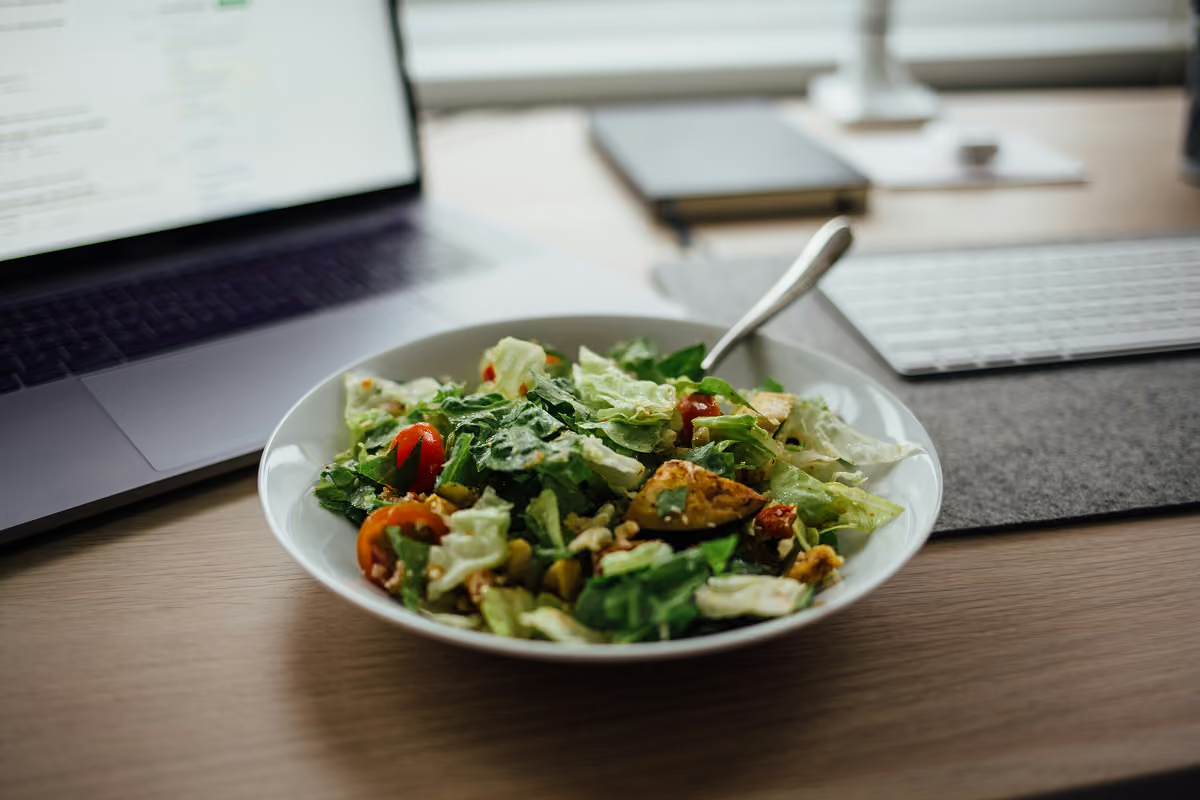
Attain’s purchase data shows consumers didn’t buy less lettuce after the cyclospora outbreak — they stopped buying it altogether. What comes next depends on whether brands can do something they’ve rarely managed in a food safety crisis: earn trust back.
When the FDA traced a cyclospora outbreak to iceberg lettuce processed at a Taylor Farms facility in central Mexico this summer, the consumer response was swift,broad, and. —according to Attain’s purchase data— revelatory.
Lettuce sales dropped precipitously. Consumers didn’t reduce how often they shopped for lettuce — many simply avoided the leafy greens entirely.
Attain’s permissioned receipt data, covering the 26 weeks ended August 16, 2026, shows that weekly buyers of the two recalled Walmart-brand iceberg products — Marketside Shredded Iceberg and Marketside Classic Iceberg Salad — fell 41% and 49% below their pre-outbreak baselines in the three weeks following the July 17 product removal.
Among the shoppers who kept buying those products, purchases barely moved, averaging 1.05 to 1.07 transactions per week, nearly identical to pre-outbreak levels. The decline, then, reflected a different cohort’s activity, indicating, amongst them, a hard stop in lettuce buying as opposed to merely cutting back.
The numbers demonstrate what really happens during a food scare and should change the way brands try to model the recovery. It’s one thing if the problem is hesitation among existing buyers. But when a large share of buyers simply disappear en masse, that’s a dramatic disruption that requires an equally dramatic response.
Guilt by Category Association
The flight from iceberg extended well beyond the recalled products. Fresh Express Shredded Iceberg, which was never named in the recall, lost 66% of its buyers over the same period. Kroger Shredded Iceberg fell 37%, according to Attain’s findings. The bagged salad category as a whole, including romaine, spring mix, slaws, and salad kits with no connection to the outbreak, fell 22%.
Still, there were some outliers. Loose (unpackaged) iceberg heads held up best, falling only 8%. That suggests some shoppers briefly shifted toward whole-head lettuce before seemingly leaving iceberg lettuce for the time being. Loose lettuce head purchases spiked to an index of 145 in the week of June 29 before declining with the rest of the category.
The same calendar weeks in 2025 showed no comparable summer decline, with the category holding between 96 and 104 against its own baseline. But seasonality trends just offer context, not a direct comparison when an unusual event like a foodborne illness strikes.
“Fear doesn’t read labels”
CNBC reported that lettuce prices fell 16.4% from June to July, the largest one-month decline on record according to Bureau of Labor Statistics data, as restaurant chains reported meaningful sales impacts. As the business network reported, Sweetgreen lowered its full-year outlook. Chipotle estimated a roughly two-percentage-point sales impact in the back half of July. Dollar sales of prepackaged salads fell 14% during the four weeks ended July 25, according to NielsenIQ.
Allen Adamson, co-founder of brand consultancy Metaforce, frames the category dynamic bluntly. “Fear doesn’t read labels,” Adamson says. “One contaminated batch and every salad in America looks suspect. Sweetgreen never touched the implicated lettuce and still took the hit. In a food scare, the category gets convicted, not the culprit.”
What Consumers Say They Need
A survey of 1,086 U.S. respondents conducted by market research firm Ideally found that trust, not taste or price, is the obstacle to recovery.
Over half of respondents remain hesitant to return to salads: 37% say they feel most confident eating salads made at home from ingredients they choose themselves, and 19% say they still do not feel confident at all.
Brands seeking to accelerate the recovery face a specific communication challenge, as Ideally found that 37% of respondents also said they would feel more confident if food brands and retailers posted current food safety updates; another 30% said they wanted clear explanations of how fresh ingredients are washed and handled.
The top three message categories respondents say would move them — safety and handling, freshness and quality checks, and transparency about what has changed — are all “reassurance-oriented” and together account for roughly half of all responses.
And yet, 14 percent told Ideally that nothing will work and have written the category off entirely.
Joshua Nu’u Steele, co-founder and chief revenue officer at Ideally, argues that the sequencing of brand communication is as important as its content. “Understanding where consumers currently are determines not just what to say, but when to say it,” Steele says. “A brand that leads with craveability before addressing safety risks looking like it’s minimizing the concern. Brands risk making expensive decisions based on assumptions about whether consumers are still in ‘prove you’re safe’ mode or ready for ‘remind me why I liked it’ mode.”
The Tylenol Standard
Adamson is skeptical that conventional crisis communications will move the needle.
“Messages of reassurance don’t move the social media needle,” he says. “‘Your safety is our top priority’ is wallpaper. Everyone says it. Nobody hears it.” His benchmark is the 1982 Tylenol crisis, when Johnson & Johnson pulled every bottle from every shelf and invented tamper-proof packaging. “They didn’t reassure the market,” Adamson says. “They changed the product.”
The application to the current crisis is direct. “Don’t tell me your lettuce is safe,” Adamson says. “Show me something I’ve never seen. Put the farm name on the bowl. Post the test results daily. Invite cameras into the supply chain. The brand that does something unexpected wins back the salad. The brands that issue statements stay stuck in the crisis.”
Attain’s data suggests the window for that kind of intervention is open but not unlimited.
Buyers left decisively at the moment of the recall, Attain noted. Meanwhile, the 14% of consumers Ideally identifies as having sworn off the lettuce for at least the moment represent a floor of permanent loss the industry will need to plan around. For the majority who remain reachable, the data points to a consumer waiting to be shown something, not told something.



Stay ahead of the story.
Get the latest from The Outcome—expert takes on the industry, emerging trends and exclusive insights into how consumers are actually spending.