Halloween Comes Earlier Every Year. Are Consumers Actually Ready For Marketers’ Tricks and Treats?
Purchase data indicates ‘yes,’ but the advertisers paying attention know the real problem isn’t timing. It’s sameness.
Walk through any big-box retailer in August and the pumpkins are already out, the skeleton displays are assembled, and the seasonal candy is stacked high. The eye-rolls are out too as consumers take in their first breath of a store’s air conditioning. But the spending is happening even when the temperature is above 90 degrees.
Halloween spending hit a record $13.1 billion last year, according to a recent report by the NRF, as nearly half of consumers (49 percent) begin their shopping before October — a figure that has risen steadily from 34 percent a decade ago.
One-in-four shoppers had already purchased Halloween items as of early August, according to NRF’s 2026 survey conducted by Prosper Insights & Analytics. Adult costumes and candy led early purchases, and the share of early shoppers who had already bought children’s and pet costumes by early August doubled compared to last year.
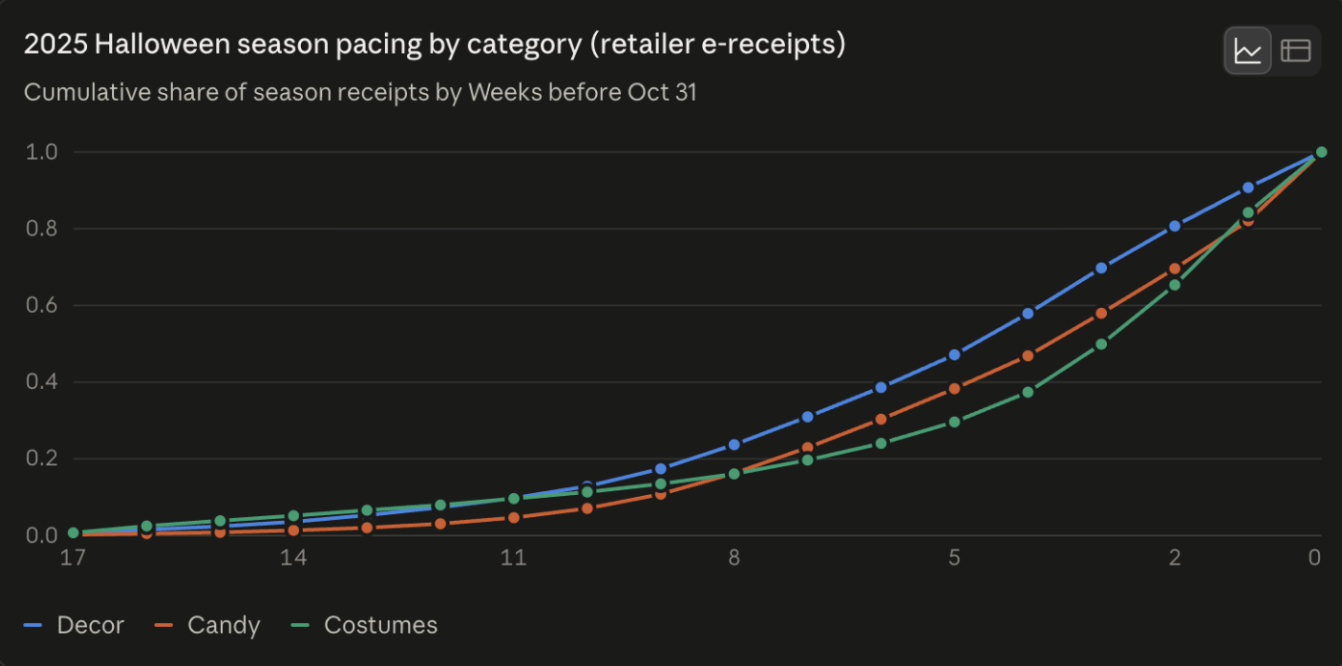
Attain purchase data continues to show Halloween well-solidified as a legitimate season for consumers as it bleeds earlier into fall, with decor leading the category in early spending for 2025. While consumers might bemoan seeing the displays come on the shelves in August, they’ll actually consider buying from it a couple weeks later.
Rishi Chandiramani, head of sales at mobile marketing provider Big Happy, points to a dynamic that makes the early season particularly valuable from a pure sales mechanics standpoint. “Shoppers, like myself, buy candy early because they’re excited for fall, eat it themselves before Halloween even arrives, then have to go back and buy more for actual trick-or-treaters,” Chandiramani says. “That’s two sales cycles instead of one to capitalize on.”
Retailers, he argues, didn’t invent the early season. They caught up to it.
Two Kinds of Shoppers, Two Different Windows
Allen Adamson, co-founder of brand consultancy Metaforce, cuts the consumer population in a way that clarifies why early marketing produces results even when it also produces complaints.
“There are two kinds of parents on Halloween,” Adamson says. “The planner remembers their child’s disappointment at having the same costume as everyone else and won’t let it happen again. The procrastinator walks into Target on October 29 and takes what’s left.”
The NRF data supports that segmentation. Fall weather is a meaningful trigger for early shoppers, with 42 percent of Halloween celebrants saying cooler temperatures inspire them to start buying. That effect is strongest in the Midwest and Northeast, where fall arrives earliest, and weakest in the Mountain region, where warmer states like Arizona and New Mexico lag behind.
Economic pressure is shaping the timing, too. NRF’s survey found that 54 percent of consumers shopping for winter holidays before November said they were doing so specifically to spread out their budget — a figure that mirrors the 59 percent of back-to-school shoppers who said the same. Inflation and tariffs were cited by 54 percent and 40 percent of respondents, respectively, as negatively affecting their view of the economy. The early Halloween shopper, in many cases, is a budget-conscious shopper making deliberate decisions about when to spend.
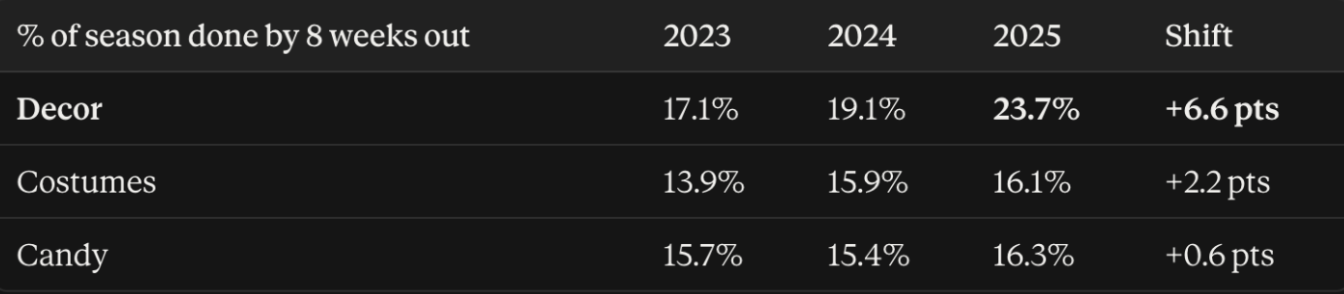
Attain data also shows consumers shifting their Halloween spending earlier year-over-year, mirroring the increased prices and inflation that started with Covid. Anywhere from one fifth to a quarter of spending was captured by 8 weeks out, according to Attain data. Whether economic factors are contributing to this trend is unknown, but the data doesn’t contradict the theory.
The Real Problem Is Predictability
Consumer fatigue, where it exists, isis not caused by early advertising too early, says Josh Heller, CRO at CoactiveAI. In fact “the fatigue isn't about timing, it’s about predictability,” Heller says. “Seasonal campaigns get planned months out, because planning ahead is the only option when you can’t react to anything. And when you’re planning that far out, the holiday is the only reference point you have, so every brand lands on the same few ideas.”
The result: “Scary good deals.” “Face your fears.” Every brand competes for the same moment, pushing it earlier each year. “Consumers aren’t worn out by the volume,” Heller says. “They’re worn out by seeing the same thing, sooner.”
The alternative, he argues, requires brands to read context as it happens rather than schedule against a calendar date. That entails brands finding their own moment rather than renting the same one as everyone else.
Saturday Changes the Basket
This year carries a structural advantage that practitioners say marketers should be factoring in. Halloween falls on a Saturday for the first time since 2020. Adamson says the calendar shift matters more than it might appear. “Saturday means parties, not just trick-or-treat. Parties mean adults, decor, and bigger baskets.”
The occasion expands beyond children’s costumes into adult entertaining, home decoration, and food and beverage. The good news for marketers is that these are all categories with higher average ticket sizes and broader brand participation opportunities.
Chandiramani is watching several trends he expects to define the season. AI is emerging as a shopping and planning tool, with consumers using it to generate costume ideas and spooky content for social gatherings. DIY and budget-conscious costuming are making a comeback, driven by economic pressure and a wider crafting resurgence. And brands are investing in higher-production creative — 3D and CGI executions — to cut through a market where static product imagery no longer holds attention during peak seasonal scroll.
“With so much noise in the market this time of year, a static image or a straightforward product shot doesn’t cut through anymore,” Chandiramani says.
The costume itself has also moved platforms. “Kids don’t want just any costume,” Adamson says. “They want the one TikTok says is ‘the hottest.’ The one that sells out isn’t on the shelf. It’s on the feed.”



Stay ahead of the story.
Get the latest from The Outcome—expert takes on the industry, emerging trends and exclusive insights into how consumers are actually spending.