The Backlash Against AI Slop Marketing Content
.avif)
Consumers are getting better at identifying AI-generated content, and they don’t trust the brands that use it.
Late last month, LinkedIn added a new feature to help rid its feed of “slop,” low-quality content created by AI platforms. A new button allows users to report content that “Seems like AI slop,” just the latest sign that there is consumer pushback against AI-generated content.
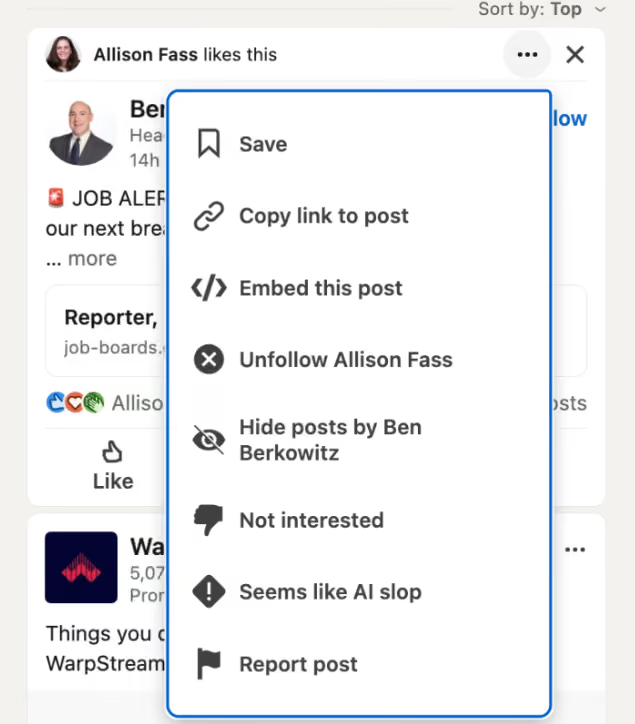
AI has been promoted as a revolutionary technology for the advertising and marketing industries, particularly for its ability to produce creative assets, and execute and optimize ad campaigns in a fraction of the typical time and effort. But for all its industry-changing potential, AI has one key problem: a lot of consumers don’t seem to particularly like AI-created content.
Brands posting AI-generated social media content is the top concern among consumers in the U.S., UK and Australia, tied with brands mishandling their data. Nearly a third of consumers say a brand using AI-generated content in their marketing will make them trust the brand less. Half of consumers say that they would prefer to give their business to a brand that doesn’t use generative AI over one that does.
One might assume that negative sentiments about AI are limited to older consumers frightened and confused by this new-fangled technology, but studies show young consumers are just as, if not more, skeptical of AI. Almost three-quarters of Gen Z consumers have taken a negative action against a brand — such as unfollowing it on social media, unsubscribing from its newsletter, or posting a negative comment online — after realizing the brand used AI-generated content in its marketing.
AI skepticism is why Instagram started posting advisory notices on content it deems as likely created with AI. Pinterest has gone even further, allowing its users to completely filter out AI-generated content from their feeds.
That the two most prominent visual platforms on the internet are wary of AI content is telling.
The problem, it seems, is one of trust. AI-generated content is incredibly easy to make and inherently fake, and using it in an ad seems to indicate a lack of care for one’s own brand and its customers. As Brian Morrissey, editor of media industry newsletter The Rebooting, often says, putting in effort “shows that you give a shit.”
Consumers were so upset by a summer 2024 Google Gemini ad showing a young girl using AI to write a letter to her favorite athlete that Google pulled it. (The ad itself wasn’t AI generated, but the response exhibits a strong anti-AI sentiment no less.) Consumers were similarly displeased when Coca-Cola used AI to create the 2025 version of its iconic annual Christmas commercial. “The most profitable commercial in Pepsi's history,” reads the top comment on the YouTube post of the commercial. Some Vogue readers said they wanted to cancel their subscriptions after the magazine featured AI-generated models in ads for its August 2025 issue.
Consumers’ distaste for AI-generated content is a rich irony considering consumers love to use AI themselves. AI is often cited as the most rapidly-adopted technology in human history.
Awe at the power of AI tools has dropped precipitously in recent years, however. In just three years, the number of consumers who prefer AI-generated content to traditional content has dropped from 60 percent in 2023 to 26 percent in 2025. The novelty has worn off.
As AI generative AI programs have become popular, consumers have developed a sense for identifying (and calling out) content that is synthetic. In text, it's overwrought emotionality; clunky word choices; overwrought metaphors; the Rule of Three; “Not this, but that” syntax; and a slavish adherence to grammatical correctness, often at the expense of readability and clarity. For images and videos, AI content often has an overly slick, plasticky sheen and is densely layered with text and imagery, making the image feel overstuffed.
But AI skepticism also presents a unique opportunity for marketers: They can score points with consumers by emphasizing that their content is handmade, without the help of AI.
This March, high-end cookware brand Le Creuset released an Instagram Reel of a boat in the shape of one of Le Creuset’s signature Dutch ovens. In the comments, Le Creuset pointedly noted that no AI was in its creation — the background was shot live in Collioure, France, and the boat is an original work from a digital artist. The user comments are overwhelmingly positive.



Stay ahead of the story.
Get the latest from The Outcome—expert takes on the industry, emerging trends and exclusive insights into how consumers are actually spending.